
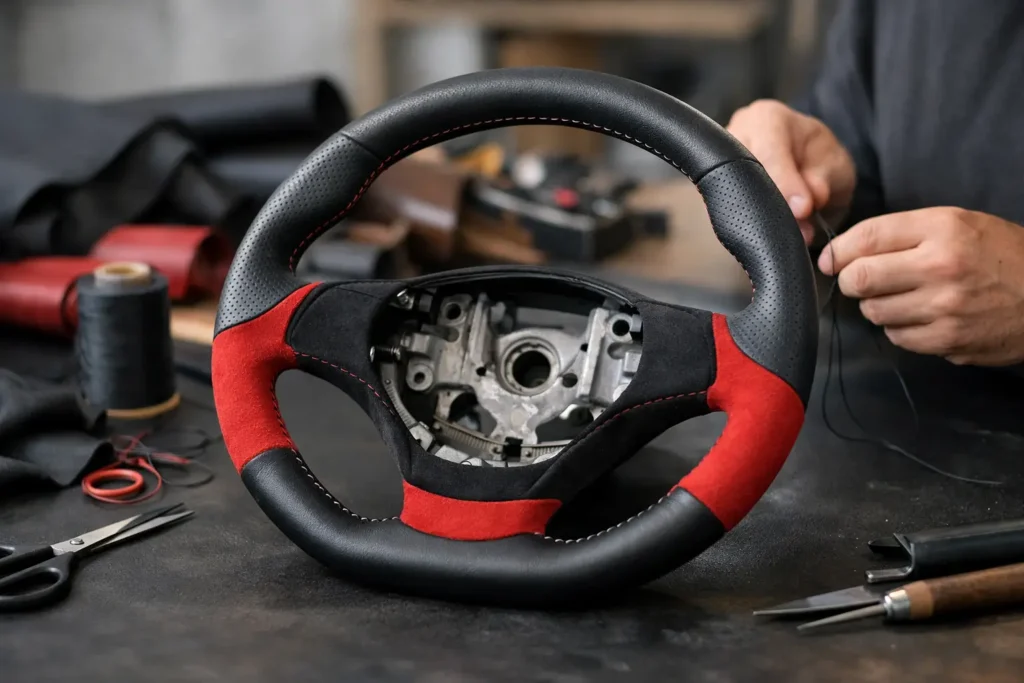
A steering wheel tells the truth about a vehicle faster than almost any other interior part. Seats can be cleaned. Carpet can be replaced. Trim can be polished. But when the wheel is shiny from wear, cracked at the top, peeling at the seams, or sticky from failing material, the whole cabin feels tired the second you touch it. That is exactly why custom steering wheel reupholstery matters. It fixes the part you see and feel every time you drive, and it can bring an otherwise solid interior back to life.
For some owners, the goal is restoration accuracy. For others, it is a full upgrade in leather, suede, color, grip, or contour. Either way, the difference between an average result and a professional one comes down to fit, material quality, stitching precision, and knowing how the original wheel was built.
What custom steering wheel reupholstery actually changes
A worn steering wheel does more than look old. Damaged leather, loose wrapping, faded dye, and flattened padding change how the wheel feels in your hands. On a daily driver, that can make the cabin feel neglected. On a luxury, performance, or collector vehicle, it can drag down the value of the entire interior.
Custom steering wheel reupholstery restores the outer surface and, when needed, corrects the shape beneath it. That means the work is not limited to swapping in a new piece of leather. A properly rebuilt wheel can address cracked or hardened material, worn thumb grips, uneven contours, damaged seams, discolored sections, and outdated finishes that no longer match the rest of the cabin.
This is also where customization becomes useful rather than flashy. A driver who wants a factory-style wheel may choose OEM-style leather and matching stitch color. Someone building a sportier interior may prefer perforated leather on the sides, smooth leather on the top and bottom, thicker grips, or a contrasting stitch pattern. The right setup depends on the vehicle, the intended use, and how original or personalized the owner wants the finished interior to feel.
When reupholstery makes more sense than replacement
Many owners start by looking for a replacement wheel, then run into the same problems. New OEM parts are often discontinued, expensive, or unavailable in the right trim. Used wheels can be just as worn as the one already in the vehicle. Cheap aftermarket replacements rarely match factory fit, factory electronics, or airbag compatibility expectations.
Reupholstery often makes more sense because it preserves the original core. That matters on vehicles with rare factory wheels, heated wheel systems, integrated controls, or model-specific shapes that are difficult to duplicate correctly. It also matters for classic vehicles where originality has value and for high-end vehicles where the wrong grain, thickness, or stitch style stands out immediately.
There is a trade-off, of course. If a wheel structure is heavily damaged, bent, or previously repaired badly, the job may require more restoration work than a simple recover. But in most cases, keeping the original wheel and rebuilding it correctly delivers the best combination of fit, function, and finish.
Materials matter more than most people expect
The fastest way to spot a low-end steering wheel recover is by touch. The leather feels plastic-like, the seams look bulky, the wrap sits loose around corners, and the finish starts wearing too soon. Steering wheels take constant friction, skin oils, heat, and UV exposure. That makes material choice critical.
Genuine automotive leather remains the standard for most applications because it balances durability, appearance, and comfort. It can be finished to look factory-correct or upgraded with different textures and perforation patterns. Suede and Alcantara-style materials can create a more performance-oriented feel, especially for enthusiast builds, but they are not always the best fit for every driver. They can show wear faster in daily use and need more careful maintenance.
Padding and substrate preparation matter just as much as the outer wrap. If the underlying wheel has worn low spots, hardened sections, or damaged contours, premium leather alone will not solve the problem. A clean finish starts with proper shaping so the wheel feels consistent all the way around.
Custom steering wheel reupholstery options that add value
The best custom work is intentional. It improves the wheel without making it look out of place inside the vehicle.
For restoration projects, that usually means matching the original grain, seam placement, stitch style, and color as closely as possible. For modern upgrades, owners often choose a thicker profile, thumb grip enhancement, perforated side sections, smooth top and bottom sections, color-matched stitching, center stripe additions, or two-tone layouts that tie into seats, dash trim, or shifter details.
Carbon fiber style accents, painted trim sections, and mixed-material combinations can also work well, but only when the rest of the interior supports the look. A custom wheel should feel integrated, not added on as an afterthought. In high-end interiors especially, restraint usually ages better than trend-driven design.
That is one reason specialist shops tend to get better outcomes than generic upholstery providers. Steering wheels are small parts with very visible details. There is nowhere to hide uneven stitching, poor edge transitions, or material mismatch.
Why steering wheels are harder to upholster than they look
At a glance, a steering wheel seems simple. In practice, it is one of the more demanding interior parts to recover properly.
The wheel has tight curves, compound shapes, hand-contact wear points, spoke transitions, and safety-sensitive surrounding components. On newer vehicles, there may be heating elements, control switches, trim bezels, paddle shifter cutouts, and very specific seam locations. On classic wheels, there may be restoration concerns involving original geometry, molded sections, or matching aged interior components.
Good reupholstery requires more than wrapping material around a ring. Patterns must be cut accurately. Stitch lines need to stay straight under tension. The cover must fit tightly without bunching, twisting, or lifting over time. Material thickness must be chosen carefully so the wheel does not become awkwardly oversized or lose definition at the spoke edges.
That is why in-house craftsmanship matters. When the same specialist handles stripping, prep, material selection, sewing, wrapping, and finishing, the final result is usually far more consistent than a pieced-together process.
What to expect from a professional send-in process
For most vehicle owners, steering wheel reupholstery is a send-in service. You remove your original wheel or send a spare, the shop completes the restoration or customization, and the finished part is shipped back ready for reinstallation.
This model works well because it gives owners access to specialists without being limited to local upholstery shops that may only handle general interior work. It also allows for more precise communication around material options, stitch color, finish type, and factory versus custom goals.
A reputable process should be clear from the start. You should know what materials are available, whether your make and model is supported, what condition issues can be repaired, and what the finished result is intended to look like. Before-and-after examples matter here because they show whether the shop can actually deliver clean seams, sharp contours, and factory-level detail.
Craft Customs built its reputation around exactly that kind of specialized, in-house work, serving everything from daily drivers to rare and high-end vehicles with restoration-focused precision.
How to know if your wheel is a good candidate
Most worn wheels are repairable, even when they look rough. Cracked leather, faded surfaces, loose stitching, shiny grip areas, peeling topcoats, and minor contour wear are all common issues that professional reupholstery can correct.
What matters is the condition of the wheel underneath. If the frame is intact and the wheel has not been structurally compromised, there is usually a strong path to a like-new or customized result. Heated wheels, multi-function wheels, and model-specific designs can often be serviced as well, but they require experience and careful handling.
If your vehicle interior still looks good but the steering wheel does not, that mismatch is often your sign. The wheel has become the weak point. Fixing it can make the entire cabin feel newer, cleaner, and better cared for without replacing half the interior.
A well-finished steering wheel changes the driving experience in a way owners notice immediately. The grip feels right. The color matches. The seams sit where they should. The wheel stops distracting you every time you get in the car. When the part you touch most finally looks and feels correct, the rest of the interior tends to fall back into place. That is the value of craftsmanship done with purpose.