
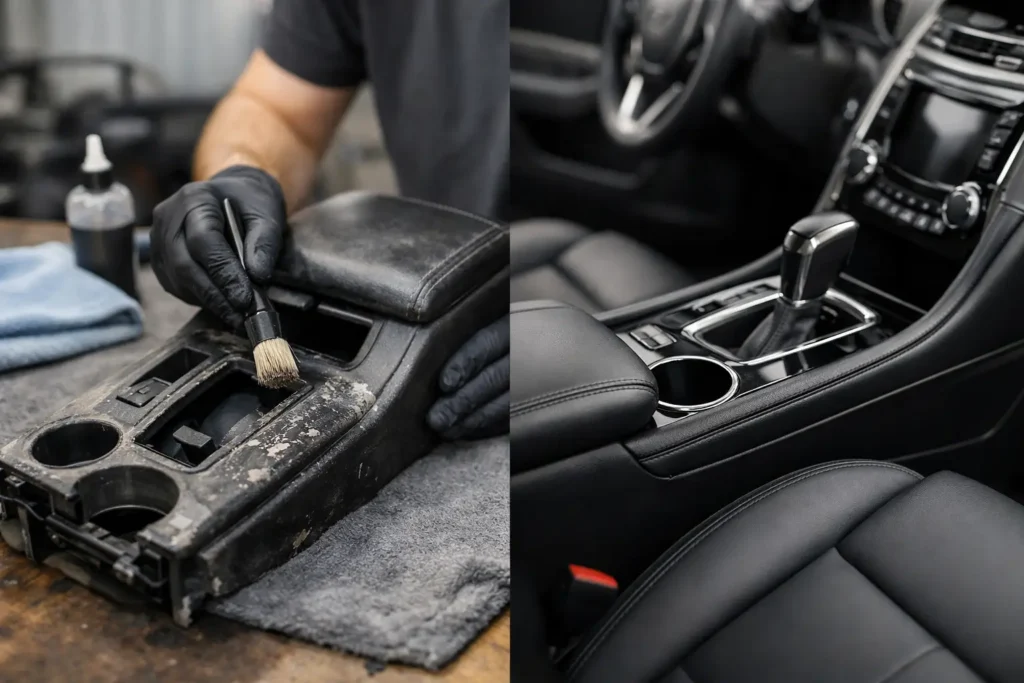
A worn center console can make a solid vehicle feel tired every time you get behind the wheel. Cracked lids, faded trim, peeling coatings, scratched panels, damaged side pieces, and broken finish around the shifter area are exactly why a professional center console restoration service exists. When the console is restored correctly, the interior feels tighter, cleaner, and far more valuable without the fitment problems that often come with trying to replace original parts.
For many owners, the console is one of the most touched and most visible parts of the cabin. Your arm rests on it. Your hand reaches across it. Passengers notice it immediately. That means even moderate wear stands out, especially in luxury cars, classics, performance builds, and well-kept daily drivers where the rest of the interior is still in good shape.
What a center console restoration service actually fixes
A true restoration service does more than clean a part and spray fresh color over it. The work usually starts by evaluating the underlying material and the type of damage. Leather, vinyl, plastic, woodgrain, painted trim, soft-touch coatings, and carbon fiber style surfaces all age differently, and each one requires a different repair path.
On leather or vinyl console lids and armrests, common issues include collapsed padding, split seams, wrinkling, surface cracks, and worn color. These parts can often be reupholstered, re-padded, and refinished so they look and feel much closer to factory new. If the stitching pattern matters, especially on premium or vintage interiors, that detail needs to be matched correctly or the part will always look slightly off.
Hard trim pieces around the console tend to suffer from scratching, peeling clear coat, fading, chips, and damage from keys, rings, drinks, or cleaning chemicals. Woodgrain finishes may need stripping and refinishing. Painted trim may need surface correction and color matching. Soft-touch coatings can become sticky or wear through, which calls for proper removal and refinishing rather than a cosmetic cover-up.
Then there are the parts people often forget until the console is removed – shifter bezels, side trim, switch surrounds, cupholder doors, e-brake trim, and small accent panels. If these are left worn while the main lid is restored, the console can still look incomplete. That is why the best results usually come from treating the console as a group of related components, not one single panel.
Why restoration often beats replacement
Replacement sounds easier on paper. In practice, it depends on the vehicle, the trim level, and how exact you want the result to be.
For newer mainstream vehicles, replacement may be possible if brand-new OEM parts are still available at a reasonable price. But even then, costs add up quickly once you include multiple trim pieces, lids, side panels, and matching adjacent parts. Some factory finishes also change over time, so a new piece can look cleaner than everything around it instead of blending naturally.
For older vehicles, luxury models, rare trims, and discontinued platforms, replacement becomes much harder. Used parts may be just as worn as yours. Salvage pieces often arrive with hidden scratches, broken tabs, sun fading, or mismatched grain and color. That is where restoration has a clear advantage. You keep your original part, preserve factory fitment, and rebuild the finish or upholstery with much more control over the final look.
There is also the customization side. Some owners do not want stock. They want a console lid in leather that matches a custom steering wheel, a woodgrain refinish that corrects faded factory tone, or painted trim that updates an outdated interior. Restoration opens that door while still keeping the underlying part designed for the vehicle.
What to expect from the restoration process
The process should begin with an honest assessment, not a blanket promise. Some pieces are ideal candidates for restoration. Others may need partial rebuilding, reupholstery, refinishing, or a combination of services. The right approach depends on the material, the severity of wear, and whether the goal is factory-correct restoration or a custom upgrade.
In a typical send-in service, the customer removes the console components and ships them to the shop. That matters because working on the actual OEM parts allows the finish, structure, and fitment to be handled directly rather than approximated from universal materials. Once the parts are received, the damaged surfaces are cleaned, stripped, repaired, sanded, re-covered, refinished, dyed, painted, or clear coated as needed.
This is where craftsmanship shows. Good prep work is the difference between a finish that lasts and one that fails early. Surface contamination, old coating instability, weak edge work, or poor material selection can cause peeling, color mismatch, or texture problems. A specialist shop that handles interior components every day is far more likely to catch those issues before the cosmetic stage starts.
After restoration, the parts should be inspected for finish quality, color accuracy, stitching consistency, and overall presentation. On premium interiors, even small flaws are noticeable. The grain, sheen, and panel contours all need to look intentional.
How to know if your console needs professional work
If the damage catches your eye every time you sit in the car, it is usually time. That said, some signs matter more than others.
Cosmetic wear like light scuffs and mild fading may seem minor, but it often spreads quickly in high-contact areas. Cracks in leather or vinyl tend to deepen. Peeling coatings rarely stop on their own. Sticky soft-touch finishes get worse with heat and regular use. A loose or collapsed armrest lid can also turn from a cosmetic issue into an annoyance every time you drive.
Professional work makes the most sense when the part is structurally worth saving, when originality matters, or when a direct replacement is hard to source. It also makes sense when you are already restoring nearby components. A fresh steering wheel next to a damaged center console will make the wear stand out more, not less.
Choosing the right center console restoration service
Not every upholstery or body shop is equipped for this kind of work. Center consoles combine multiple materials, tight tolerances, and highly visible surfaces. You want a specialist that understands interior parts, not just general refinishing.
Look for clear evidence of before-and-after results, experience across different makes and models, and the ability to handle both restoration and customization. Ask whether the work is done in-house. That matters for quality control, turnaround consistency, and accountability. It also helps to choose a shop that can restore related parts at the same time so the textures, colors, and finish levels stay cohesive.
Communication matters too. A good shop should be able to explain what is repairable, what will be reupholstered versus refinished, and where expectations need to be realistic. For example, some heavily damaged plastics may require more reconstruction than others. Some rare woodgrain patterns take extra effort to match. Some interiors benefit from restoring the console lid, shifter trim, and armrest together instead of one at a time.
Craft Customs serves this niche well because the work is centered on OEM interior parts, material-specific restoration, and finish quality that holds up under close inspection. For owners shipping parts in from across the country, that specialization matters.
Factory-correct restoration or custom upgrade?
This is where the project gets interesting. If you own a collector car, a luxury sedan, or a carefully preserved original interior, factory-correct restoration is usually the right move. The goal is to make the console look like it belongs there, not like it was recently altered. That means matching grain, sheen, color, stitching, and trim style as closely as possible.
If the vehicle is a custom build or a personal long-term keeper, a tasteful upgrade may make more sense. Leather wrapping on a previously plain lid, suede accents, paint-matched trim, carbon fiber conversion, or a revised color scheme can bring the cabin together. The key is restraint and material quality. The best custom interiors still look finished and vehicle-specific, not pieced together.
There is no single right answer here. It depends on the car, your goals, and whether resale value, originality, or personalization matters most.
Cost, value, and the result you actually feel
Owners often focus on the visible result, but the value of console restoration is also tactile. A properly restored armrest feels firm and clean. Refinished trim feels intentional. The cabin stops reminding you what is worn out and starts feeling cared for again.
Cost depends on the number of components, material type, damage severity, and whether you are restoring or customizing. A simple lid recover is very different from a full multi-piece console refinish with matching trim. But in many cases, restoration delivers better value than chasing used parts, repainting things twice, or living with an interior that drags down the whole vehicle.
If the rest of your cabin still deserves the car, the console is not a small detail. It is one of the parts that makes the entire interior feel either neglected or finished. Get that piece right, and the difference is there every time you reach for the shifter, rest your arm, or open the door and look inside.