
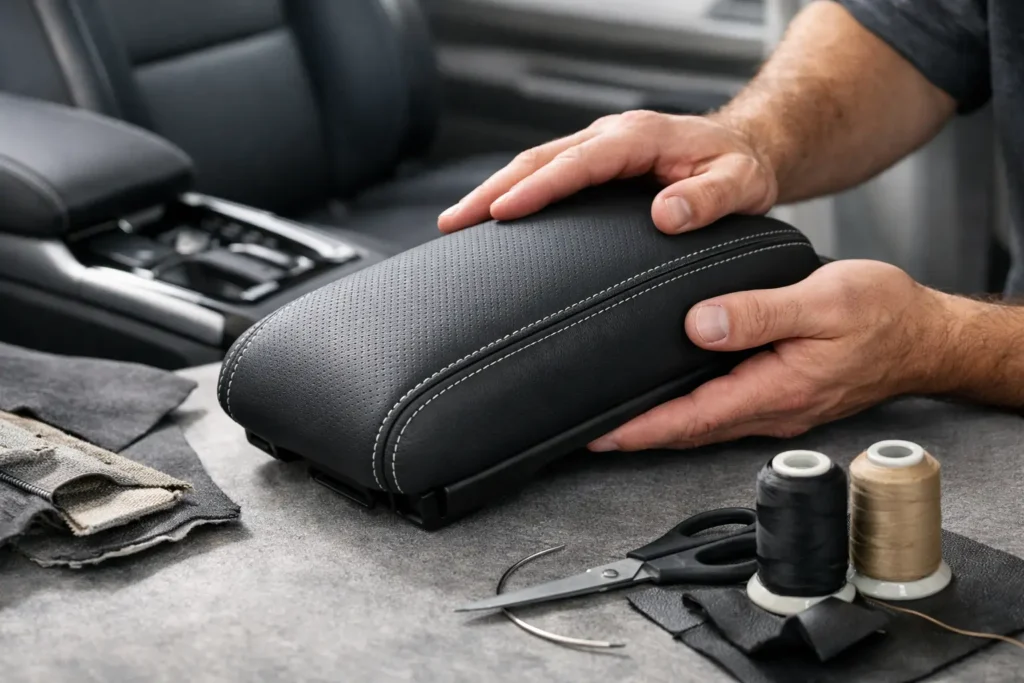
That center armrest gets more abuse than most interior parts. Elbows grind into it every day, skin oils soak in, sunlight dries the surface out, and cheap replacement covers rarely match the rest of the cabin. Armrest reupholstery for cars fixes a problem that drivers see and feel constantly, and when it is done correctly, the whole interior looks newer instead of patched together.
An armrest may seem minor compared to a steering wheel or seat set, but it sits right in your line of sight and contact. If the vinyl is split, the leather is sagging, the stitching is frayed, or the padding has collapsed, the vehicle feels older than it really is. That matters whether you own a daily driver, a restored classic, or a high-end car where interior condition directly affects value.
Why worn armrests stand out so much
Interior wear is not judged evenly. A small scuff on a lower trim panel might go unnoticed for months. A cracked armrest does not get that kind of forgiveness. It is centered, touched constantly, and usually surrounded by cleaner materials, which makes damage more obvious.
There is also a tactile issue. An armrest should feel supportive and finished. Once the top layer starts peeling or the foam underneath loses shape, the part stops feeling premium. Even in a well-kept vehicle, that one worn contact point can make the cabin feel neglected.
For resale, it matters more than many owners expect. Buyers and appraisers read interior wear as a sign of overall care. If the armrest is damaged, they often assume similar shortcuts exist elsewhere. Reupholstering it is not just cosmetic. It helps restore confidence in the condition of the whole vehicle.
What armrest reupholstery for cars actually includes
Proper armrest reupholstery for cars is more than wrapping new material over an old part. The process starts with evaluating the substrate, shape, seams, and foam condition. If the base is cracked, warped, or soft in the wrong places, new upholstery alone will not hold its shape or last.
The old cover is typically removed so the part can be rebuilt correctly. That allows the technician to inspect the foam, repair weak areas, and pattern the new skin to fit the original contours. On some armrests, tight radiuses and recessed stitch lines require careful material selection and sewing layout. On others, the challenge is matching the grain, sheen, and panel design of adjacent factory pieces.
That distinction matters because not every job has the same goal. Some owners want a factory-correct restoration that blends into the original interior. Others want a custom upgrade with smoother leather, contrast stitching, suede inserts, or a color change that ties into the steering wheel, shifter, or console lid. The right approach depends on the vehicle, the condition of nearby parts, and whether the project is about preservation or personalization.
Material choice affects both looks and service life
Material selection is where many armrest jobs go right or wrong. Vinyl is common on many OEM interiors and can be the correct choice for a factory-style repair, especially when durability and pattern matching matter most. Leather offers a richer feel and can elevate an interior, but it needs the right hide, thickness, and finish for a part that sees heavy contact.
Some owners assume softer always means better. In practice, very soft leather can stretch too easily on a frequently used armrest if it is not backed and fitted properly. A material that looks beautiful on a sample card may not hold up well over time if the grain, topcoat, or thickness is wrong for the shape and use of the part.
Color matching is equally important. An armrest sits next to seats, consoles, door panels, and trim, so a near match can still look off. The best results come from matching not just color, but texture and gloss level. Black is a good example. There are many blacks, and a deep matte black armrest next to a factory satin black interior can look like a replacement rather than a restoration.
Factory restoration vs custom upgrade
A good armrest job starts with a clear target. If the rest of the interior is original and in strong condition, factory-style restoration is usually the smart move. That means preserving the stock shape, stitching style, material type, and visual balance. The goal is for the repaired part to stop drawing attention.
Custom work makes sense when the vehicle already has upgraded interior elements or when the owner wants a deliberate transformation. That can include changing vinyl to leather, adding double-row stitching, introducing suede, or tying the armrest into other custom pieces. Done well, these upgrades look integrated rather than added on.
There is a trade-off. Factory-correct work tends to support originality and resale in collector and restoration markets. Custom work can improve comfort and visual impact, but only if the rest of the interior supports it. A one-off custom armrest in an otherwise stock cabin can feel disconnected. In a fully coordinated build, it can become one of the details that makes the entire interior feel complete.
Why replacement covers and cheap local fixes often disappoint
Owners often try to solve armrest damage with slip-on covers, universal skins, or quick upholstery work. The problem is fit. Armrests have specific contours, hinge clearances, latch points, and seam locations. If the cover is too loose, it wrinkles. If it is too tight, it pulls at the edges and distorts the foam underneath.
Low-cost local repairs also tend to focus only on the visible surface. That may hide damage for a short time, but if the foam is broken down or the substrate is compromised, the new material will not sit properly. You end up paying for the same part twice.
Stitching is another giveaway. Uneven seam spacing, bulky edge wraps, and thread color that does not match the design language of the interior will stand out immediately. On premium cars, classics, and collector vehicles, those details matter. They are the difference between a repaired part and a refined one.
When a send-in service makes more sense
For many owners, the best path is removing the armrest or console lid and sending it to a specialist. That approach works especially well when local shops are geared toward basic seat repairs rather than detailed interior component restoration. Smaller interior parts are easier to ship, easier to handle precisely on the bench, and easier to finish to a higher standard than many in-vehicle repairs.
A dedicated in-house process also allows better control over patterning, sewing, material handling, and final fit. That is particularly useful for rare, high-end, and older vehicles where replacement parts are discontinued or generic options are unacceptable. A specialized shop can work from the original component rather than forcing the part to fit an off-the-shelf solution.
This is where experience shows. A shop that regularly restores steering wheels, consoles, shifters, trim, and armrests understands how these components need to match each other. Craft Customs works in that space, where the expectation is not just a recovered part, but a finished interior piece that looks intentional, feels correct, and holds up under daily use.
What to expect from a quality armrest reupholstery job
The finished armrest should fit tightly without puckering, bunching, or loose corners. Seams should be straight, balanced, and positioned correctly for the design. The padding should feel supportive, not mushy or overstuffed. Most importantly, the material should look appropriate next to the surrounding cabin.
Good work does not call attention to itself for the wrong reasons. If the goal is restoration, the armrest should look like it belongs there from the factory. If the goal is customization, the part should still feel integrated with the rest of the interior rather than acting like an isolated accent.
Durability is the final test. An armrest is not a display part. It has to handle body weight, friction, heat, and repeated contact. That means the prep under the surface matters just as much as the leather or vinyl you see on top.
If your armrest is cracked, faded, collapsed, or simply out of place with the rest of the cabin, fixing it is one of the most noticeable interior upgrades you can make. Done right, it does not just repair wear. It restores the feel of the vehicle every time you get behind the wheel.