
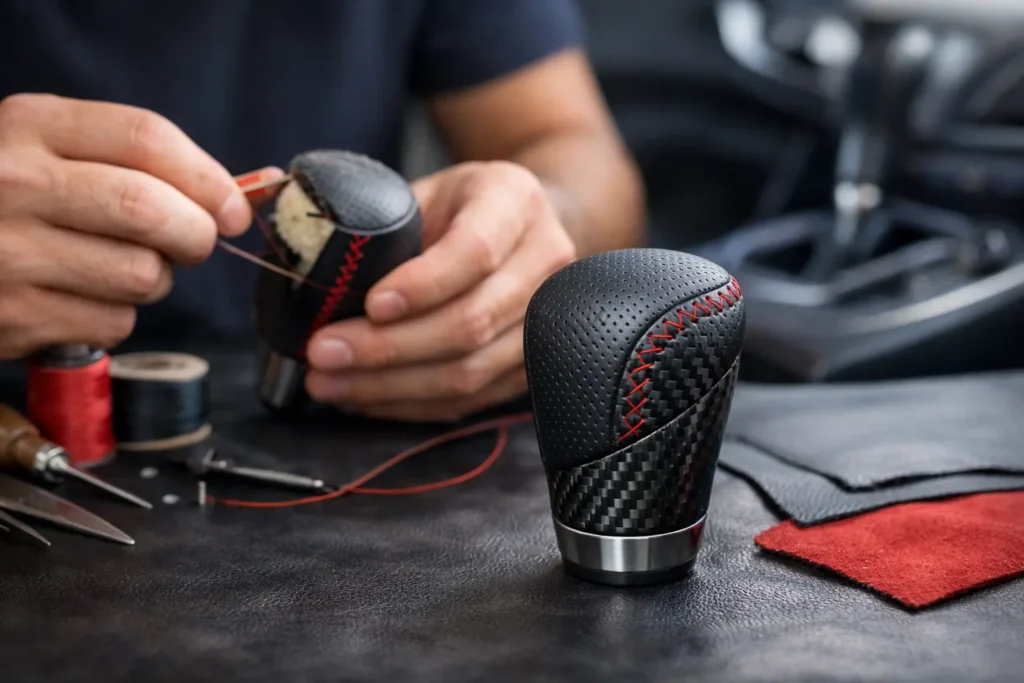
The shift knob is one of the few interior parts you touch every time you drive. When the leather is peeling, the stitching is split, or the finish feels slick and worn, the whole cabin starts to feel tired. Custom shift knob reupholstery fixes that problem at the source by restoring the part your hand notices first and upgrading it to match the rest of the interior.
A worn shifter is easy to ignore until everything around it has already been refreshed. Maybe the steering wheel has been recovered, the seats still look strong, and the trim is clean, but the shift knob still has cracks, fading, or sticky old material. That mismatch stands out. Reupholstering the knob brings the interior back into balance and gives the driver a better feel every time the car goes into gear.
Why the shift knob matters more than most people think
Interior restoration is not just visual. It is tactile. The steering wheel, armrest, and shifter form the core contact points of the cabin. If one of those parts feels worn out, the vehicle feels older than it really is.
That is especially true with a shift knob because it sits in plain view and gets constant use. Sun exposure dries the material. Oils from your hand darken it. Rings, fingernails, and repeated movement wear through leather faster than many owners expect. On some vehicles, the original covering also starts to separate at the seam or loosen around the base.
For collectors and restoration clients, damage to the shift knob can hurt the perceived quality of the whole interior. For daily drivers, it is simpler than that – a cracked or slippery knob is annoying every single day. Custom upholstery solves both problems by improving appearance and grip at the same time.
What custom shift knob reupholstery actually includes
Not every shift knob needs the same type of work. Some require a straightforward leather recover using the original shape. Others need the old material stripped, padding corrected, seam lines rebuilt, and new stitching laid out to fit the style of the vehicle.
A proper reupholstery job starts with the core structure. If the base is damaged, loose, or uneven, new material alone will not create a clean result. The surface has to be prepared correctly so the finished wrap sits tight, smooth, and durable. From there, the upholstery is cut, fitted, stitched, and installed to match either the original factory design or a custom specification.
This is where skill matters. A small part is not always an easy part. Shift knobs have compound curves, tight transition areas, and little room for sloppy seam placement. If the pattern is off, you see puckering, uneven stitching, or leather that twists under use. Good reupholstery feels secure in the hand and looks intentional from every angle.
Material choices change the result
Leather remains the most common choice because it offers the best mix of durability, comfort, and factory-style appearance. It can be matched to OEM interiors, upgraded with perforation, or finished with contrast stitching for a more performance-oriented look.
Suede and Alcantara-style materials are popular for certain custom builds, but they are not always the right answer for a shift knob. They offer a soft, high-end feel, yet they also show wear faster in a high-contact area. If the vehicle is driven often, leather usually holds up better over time.
Some owners want an exact stock restoration. Others want the shift knob to tie into a custom steering wheel, e-brake handle, center console lid, or seat accents. In that case, details like thread color, top marker placement, perforated side panels, or two-tone material layouts can make the knob look integrated rather than added on as an afterthought.
The right material choice depends on how the car is used. A weekend show car can tolerate finishes that require more care. A daily driver benefits from practical durability. A classic restoration may need period-correct grain and stitching style. There is no single best option for every build.
Factory look or custom look
Most customers fall into one of two directions. They either want the knob to look factory new, or they want it to look better than factory.
Factory-style work focuses on preserving the original shape, seam layout, and color tone so the part looks correct for the vehicle. This matters for high-end European interiors, classic restorations, and owners who want everything to appear original but fresh. When done right, the shift knob should not call attention to itself. It should simply look like the car has been cared for properly.
Custom work gives you more freedom. Black leather with red stitching is the obvious example, but there are more refined ways to customize. You can match OEM sport packages, carry over interior accent colors, use perforated leather on the side grips, or coordinate the shifter with a reupholstered steering wheel and parking brake handle. The best custom interiors are cohesive. They do not look random.
That balance matters. Too little customization and the interior may still feel dated. Too much and the part can look out of place against factory seats, trim, and console materials. Strong craftsmanship is not only about execution. It is also about knowing when to keep the design clean.
When repair is possible and when full reupholstery is better
Some owners ask if a shift knob can simply be touched up. Sometimes, yes. Minor discoloration or light cosmetic wear may be improved with refinishing, depending on the material and construction. But when the leather is cracked, peeling, loose, or heavily worn through, full reupholstery is usually the better long-term fix.
Patchwork repairs on a high-contact part rarely age well. The area gets handled constantly, and any weak point tends to fail again. Reupholstery replaces the worn outer layer entirely, which gives the part a cleaner finish and more reliable durability.
This is also why cheap replacement covers often disappoint. Universal wraps and slip-on kits may seem convenient, but they seldom fit tightly enough to look professional. The stitching can sit crooked, the material can bunch, and the knob may feel bulky or inconsistent in the hand. A properly upholstered original part retains the correct fit and shape.
The send-in process makes specialized work possible
Because shift knobs vary so much by make and model, quality work often starts with the original part. Sending in your factory knob allows the piece to be rebuilt around the exact shape, attachment method, and seam geometry it was designed with.
That matters for everything from late-model performance cars to classic restorations and luxury vehicles with uncommon interior configurations. A specialized in-house shop can evaluate the condition of the part, confirm material options, and complete the work with better control than a generic local trim source trying to improvise around an unfamiliar component.
For customers outside driving distance, the process is straightforward. Remove the original part, ship it in, approve the material and finish details, and have it returned ready to reinstall. Craft Customs handles this kind of work every day across a wide range of vehicles, which is why consistency matters as much as craftsmanship.
What to look for before you choose a shop
If you are investing in custom shift knob reupholstery, pay attention to the details that separate true upholstery work from cosmetic cover-ups. Ask whether the work is completed in-house. Ask whether the shop can match factory color and grain closely. Ask to see before-and-after examples of shifters, not just steering wheels or seats.
You should also look at stitching quality. Straight seams, proper tension, clean transitions, and tight material fit tell you more than sales language ever will. The part is small, so mistakes are easy to spot.
A satisfaction guarantee helps too, especially when you are shipping in original parts from a valuable vehicle. You want a specialist who understands both restoration accuracy and custom design, not one who treats all interiors the same.
A fresh shift knob will not change the engine, the suspension, or the paint. But it changes the way the interior feels every time your hand reaches for it, and that is exactly why the right reupholstery work is worth doing.