
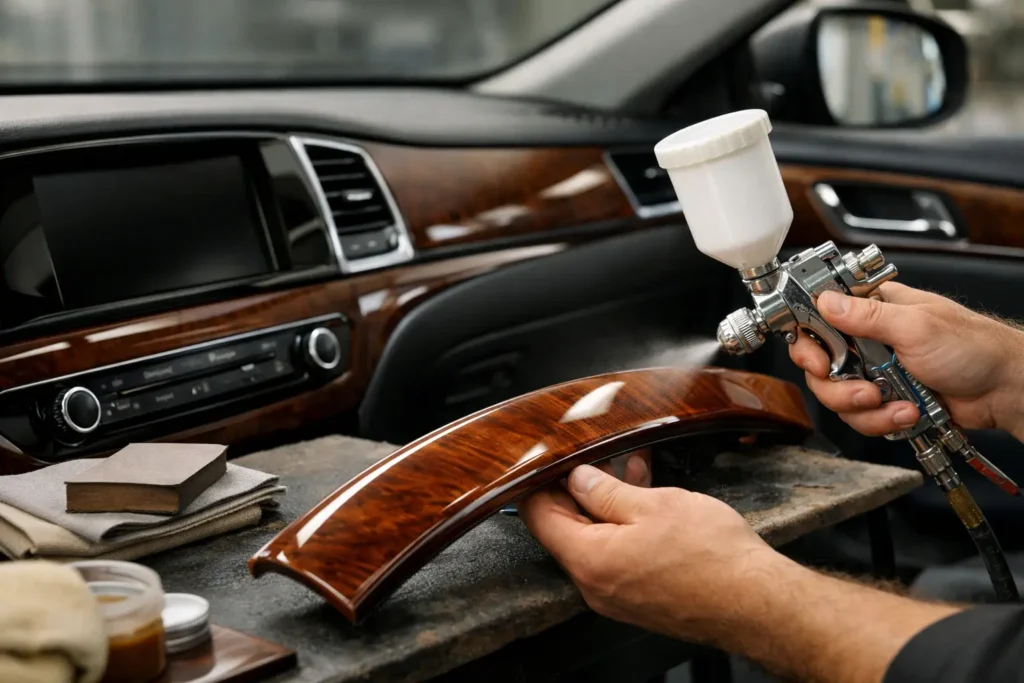
A faded woodgrain panel can age an otherwise excellent interior faster than worn carpet or a scratched sill plate. When the clear coat turns cloudy, the finish starts peeling, or the veneer shows cracks around edges and switch openings, automotive wood trim refinishing becomes one of the most noticeable upgrades you can make inside a vehicle.
Done properly, wood trim refinishing is not just cosmetic touch-up work. It is a detailed restoration process that protects the substrate, restores clarity and depth, and brings the cabin back to the standard the rest of the vehicle deserves. On luxury cars, classics, and premium daily drivers alike, damaged trim has a way of making the whole interior feel neglected. Clean, correctly refinished trim does the opposite – it makes the cabin feel cared for, valuable, and complete.
What automotive wood trim refinishing actually fixes
Most owners notice the obvious issues first. The finish may be yellowed, scratched, hazy, or lifting at the corners. In other cases, the problem is more severe. The veneer may be cracked, the clear coat may have separated from the wood, or previous repair work may have left uneven gloss and visible sanding marks.
Heat, UV exposure, skin oils, cleaning chemicals, and normal handling all take a toll over time. This is especially common on dash trim, center console panels, shifter surrounds, door trim, and ashtray lids. Vehicles that spend years in strong sun often develop finish failure that starts small and spreads quickly. Once the topcoat begins to break down, the trim usually will not improve on its own.
Good refinishing addresses more than the visible surface. It corrects the finish system itself. That can mean stripping failed clear, stabilizing the veneer, repairing cracks, rebuilding the surface, and applying a fresh finish that matches the original appearance or a new custom look.
Why DIY repairs often fall short
Wood trim looks simple until it is on the bench. Many pieces have tight radiuses, thin veneer, hidden clips, and finish layers that are easy to damage. A panel that appears to need a quick sand and re-clear can actually require careful disassembly, crack repair, color correction, and precision coating work.
The biggest DIY mistake is sanding through veneer or removing too much material around edges. Once that happens, the repair becomes far more complicated. Another common problem is using the wrong clear coat. Interior automotive trim needs the right gloss level, depth, adhesion, and durability. A finish that looks acceptable on day one can haze, chip, or amber prematurely if the material choice is off.
Matching factory appearance is another challenge. Some trims are high-gloss and deep. Others have a softer satin look. Some use real veneer with warm brown undertones, while others use simulated woodgrain that still needs a very specific color and pattern match. If the refinished piece does not match adjacent parts, the interior can look patchworked instead of restored.
The right process for automotive wood trim refinishing
The best results come from a process, not a shortcut. First, the trim needs to be inspected for substrate damage, veneer condition, finish failure, and prior repairs. That determines whether the piece can be restored to factory style, needs partial reconstruction, or makes more sense as a custom refinish.
From there, the old failing finish is removed with care. This stage matters because aggressive stripping or sanding can destroy fine details and edge definition. On real wood veneer, preserving material thickness is critical. On simulated wood trim, the technician has to work within the limits of the original construction.
Any cracks, chips, or lifted veneer must be repaired before new finish goes on. Skipping that step only traps the problem under fresh clear. Once the surface is stable, the color and grain presentation are corrected. For factory-style restoration, that means staying true to the original tone and character. For custom work, this is where a darker walnut, richer reddish tone, piano gloss, or even a completely different look can be built.
The final coating stage is where the piece gets its clarity, depth, and protection. A proper finish should look smooth under direct light, feel refined to the touch, and hold up to normal interior use. It should not look thick, plastic-heavy, or uneven from one section to the next.
Factory restoration vs custom wood trim refinishing
This is where owner goals matter. Some vehicles need strict originality. If you own a classic, a collectible, or a luxury model where factory presentation affects value, restoration should stay as close as possible to the original color, gloss, and grain style. A correct refinish preserves the vehicle’s character and keeps the interior coherent.
Other projects benefit from customization. Owners often want to modernize dated orange-toned wood, deepen the finish for a more premium appearance, or coordinate trim with a new steering wheel, console, or leather interior. In those cases, wood trim refinishing becomes part of a larger interior transformation rather than a one-for-one restoration.
Neither direction is automatically better. It depends on the vehicle, the condition of surrounding parts, and your long-term plans. A concours-minded restoration has different priorities than a custom build or a daily driver refresh.
What separates high-end results from average results
The difference is usually visible in the details. High-quality refinishing keeps edges clean, gloss consistent, and color balanced across multiple parts. There should be no trapped dust, fisheyes, cloudy areas, or obvious transition lines. The trim should fit correctly after refinishing, with no finish buildup that interferes with clips, switches, or neighboring panels.
Durability matters just as much as appearance. Wood trim sits in a harsh environment with heat cycling, sunlight, and frequent contact. If the coating system is not built for automotive interior conditions, the finish can fail again sooner than expected.
Experience with different makes and models also matters. Wood trim from a vintage Mercedes, modern Bentley, classic Jaguar, Lexus sedan, or domestic luxury car does not age the same way or require the same exact approach. Construction methods vary. So do original finish styles. That is why specialist work tends to outperform general cosmetic repair.
When refinishing makes more sense than replacement
Replacement sounds easier until you price original trim or try to source matching parts. On many vehicles, OEM trim is discontinued, expensive, or only available used in the same worn condition as your current pieces. Even when replacement parts exist, they may not match the rest of the cabin due to age, sun exposure, or production variation.
Refinishing your original panels keeps the fit, mounting points, and design consistent. It also allows damaged pieces to be restored as a set, which creates a more uniform finished interior. For rare, classic, and high-end vehicles, keeping original components is often the smartest route.
This is especially true when the wood trim is part of a broader interior restoration. If the steering wheel, shifter, console lid, and dash trim are all showing wear, restoring them together creates a result that feels intentional rather than piecemeal. That kind of consistency is what makes an interior feel factory-new or genuinely upgraded.
Choosing a specialist for automotive wood trim refinishing
If you are trusting someone with original interior parts, ask the practical questions. Do they handle the work in-house? Do they work on both restoration and customization? Can they match existing interior finishes? Do they have experience with rare, luxury, vintage, and modern applications? Those answers matter more than broad claims.
You also want a shop that understands trim as part of the whole interior, not as an isolated panel. The best results happen when woodgrain, leather, painted components, and adjacent materials are considered together. A refinished trim panel should not just look good by itself. It should make the entire cabin look better.
For owners shipping parts in from around the country, communication and process are part of the value. Clear expectations, careful handling, and a finish standard backed by real craftsmanship make the difference. That is why companies like Craft Customs focus on in-house work and visual proof of results rather than generic promises.
If your interior still looks solid except for tired wood trim, that one problem is probably doing more damage to the cabin’s overall impression than you think. Refinished correctly, those panels can bring back the richness, detail, and polish that made the interior special in the first place.