
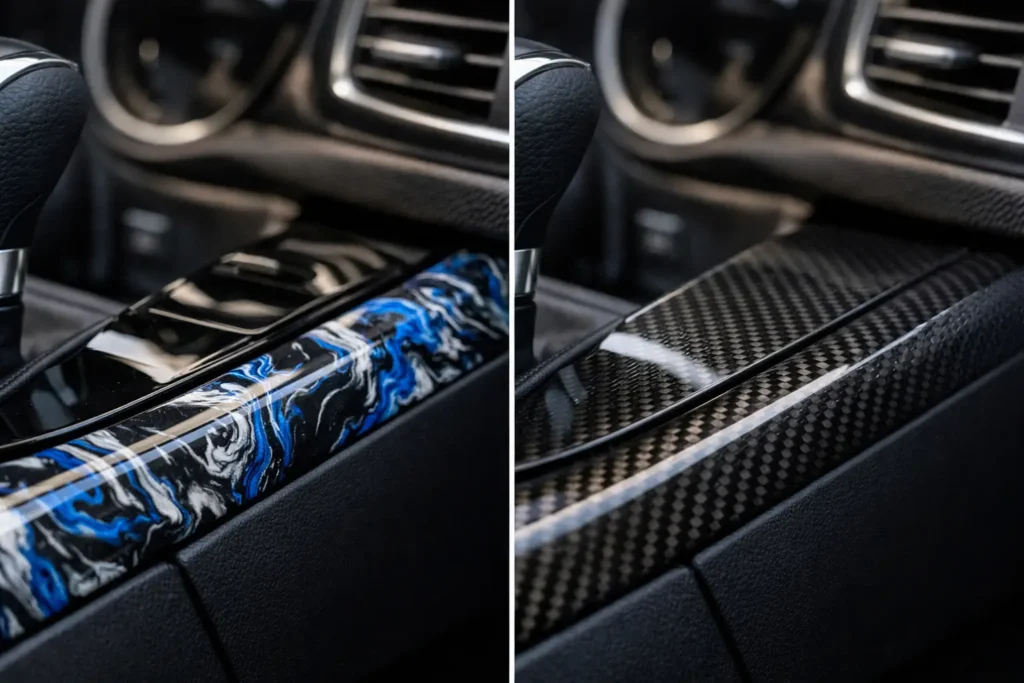
A steering wheel spoke, dash panel, or console insert can change the entire impression of a cabin. That is why the hydro dip vs carbon fiber trim decision deserves more than a quick look at a sample photo. Both can create a dramatic upgrade over faded woodgrain, scratched silver plastic, or outdated factory finishes, but they are built differently, wear differently, and deliver very different results once they are installed in a vehicle you actually drive.
The right choice comes down to the look you want, the part being refinished, your expectations for durability, and whether authenticity matters to your build. A clean hydro-dipped finish can be an excellent cosmetic solution. Real carbon fiber trim brings material depth and premium character that a printed pattern cannot fully duplicate. Knowing where each option excels keeps you from paying for the wrong result.
What Hydro Dipping Really Creates
Hydro dipping, also called water transfer printing, applies a printed film to a prepared part. The film floats on water, an activator dissolves the carrier material, and the pattern wraps around the surface as the component passes through it. The part is then rinsed, dried, and protected with clear coat.
For interior trim, the process is popular because it can cover complex shapes that would be difficult to wrap with a flat material. Steering wheel bezels, console trim, dash pieces, door switch surrounds, and small accent panels can receive a consistent pattern across curves, corners, and recessed areas. Carbon fiber-look films are among the most common choices, but hydro dipping is also available in woodgrain, camouflage, brushed metal, colored weaves, and custom graphic patterns.
The key distinction is simple: a carbon fiber hydro dip is a visual effect, not structural carbon fiber. Under the clear coat, it is printed artwork over the original substrate. When performed with careful surface preparation and a quality automotive clear coat, it can look sharp and hold up well. But it will not have the texture, weave depth, or material value of genuine carbon fiber.
Where Hydro Dip Makes Sense
Hydro dip is a practical choice when the goal is a coordinated custom appearance at a controlled budget. It works particularly well for owners who want multiple interior pieces to match, want a pattern unavailable in real composite material, or are updating plastic parts that have no performance role.
It is also useful when a factory part has intricate contours. A complex molded trim component may accept a hydrographic finish more naturally than a rigid carbon fiber overlay. The result depends heavily on preparation. Chips, peeling soft-touch coatings, silicone contamination, old adhesive, and cracked plastic must be properly addressed before any finish goes on. A pattern cannot hide a failing foundation for long.
Hydro Dip vs Carbon Fiber Trim: The Visual Difference
The biggest difference becomes obvious under direct light. Real carbon fiber has dimensional weave. Light catches the fibers at different angles, creating depth that changes as you move around the vehicle. A properly finished piece has a layered, high-end appearance that feels at home in performance cars, luxury interiors, and serious custom builds.
A hydro-dipped carbon fiber pattern remains flat beneath the clear coat, even when the print itself is detailed. From several feet away, especially in a darker cabin, a high-quality hydro dip can be convincing. Up close, the repeated printed pattern and lack of fiber depth are more noticeable. This does not make it a poor choice. It simply means it delivers a different kind of result.
Pattern alignment matters, too. Genuine carbon fiber trim can be laid out so the weave runs consistently from piece to piece. That detail gives a dashboard or steering wheel trim package a deliberate, factory-quality appearance. With hydro dipping, the way the pattern lands is influenced by the part shape and the dipping angle. An experienced finisher can control placement, but exact weave direction across every contour is more limited.
For classic vehicles, the decision may be less about realism and more about restraint. Carbon fiber can look out of place in a period-correct restoration, while hydro dipping can reproduce a decorative effect or support a more personalized restomod direction. On a modern track-focused car, authentic carbon fiber may better match the vehicle’s design language and the owner’s expectations.
Durability Depends on the Process, Not Just the Material
Neither option is indestructible. Interior parts deal with heat, UV exposure, skin oils, rings, cleaning chemicals, and constant contact. A steering wheel trim panel or center console sees much more abuse than a rear seat accent piece, so its finish needs to be selected and built accordingly.
Hydro dip durability depends on adhesion and clear-coat quality. If the original coating was not removed or stabilized, if the surface was not correctly prepped, or if the clear coat is too thin, the finish can chip, peel, haze, or scratch prematurely. A properly refinished part with an automotive-grade protective coating is far more resistant, but it is still a painted finish over an existing component.
Real carbon fiber is also usually clear coated for UV protection and gloss. The composite itself is strong, but its clear coat can still scratch, yellow, fade, or develop chips. Poorly made overlays can lift at edges or create an awkward, thick fit around switches and seams. The word “carbon fiber” alone is not a guarantee of quality. The material, resin system, fitment, surface preparation, and final finish all matter.
For high-touch interior pieces, authentic carbon fiber often has the advantage in long-term visual depth. For a large set of decorative trim pieces, a professionally applied hydro dip may offer better value while still delivering years of service. The honest answer is that durability is tied to craftsmanship as much as the finish category.
Repairability and Future Changes
A scratched hydro-dipped part can often be refinished, depending on how deep the damage goes. Light clear-coat marks may be corrected. Deeper scratches, chips, or peeling typically require stripping or sanding the affected finish and reapplying the pattern. Because each dip is influenced by placement and shape, a repaired area may not blend perfectly unless the whole part is redone.
Carbon fiber trim can also be repaired, but the repair method depends on the damage. Clear-coat defects may be sanded and refinished. Damage to the fibers or resin may require composite repair before a new clear coat is applied. A genuine piece is worth restoring when it is rare, factory-original, or part of a premium build. A low-quality overlay may be more economical to replace.
Owners should also think about reversibility. If preserving original factory trim is important, keep the original parts protected and consider refinishing a spare set. That approach is especially smart for collectible cars, limited-production interiors, and vehicles with discontinued trim pieces.
Cost: Look Beyond the Initial Price
Hydro dipping is generally less expensive than a true carbon fiber conversion because the process uses a printed film and clear finish rather than composite materials and labor-intensive fiber work. It can make sense for a full interior trim package where the goal is a unified custom look without turning every panel into a premium composite part.
Genuine carbon fiber costs more because the material itself costs more, and shaping, laying, bonding, finishing, and fitting it correctly takes time. The price can be justified when the interior is a centerpiece of the vehicle, when the build already uses authentic carbon fiber elsewhere, or when the owner wants a finish that looks unmistakably real at close range.
Do not choose solely by the lowest quote. A cheap hydro dip can fail quickly if prep work is skipped. Cheap carbon fiber can have poor weave alignment, cloudy resin, visible edges, and questionable fit. The better question is whether the shop is treating your original trim as a finished automotive component rather than a quick cosmetic project.
Choosing the Right Finish for Your Interior
Choose hydro dip when you want broad pattern options, a cost-effective custom upgrade, or a finish for complicated plastic pieces where a graphic effect is the main objective. It is a strong option for daily drivers, themed builds, and coordinated trim packages that need visual impact more than material authenticity.
Choose genuine carbon fiber trim when you want depth, premium texture, consistent weave presentation, and a material that complements a performance or luxury-focused build. It is especially compelling for steering wheel accents, dash trim, console pieces, and other areas close to the driver where the difference can be seen and felt every time you get in the car.
At Craft Customs, the starting point is always the condition of the original part and the standard you expect when it returns. The best finish is not the one with the trendiest name. It is the one that fits correctly, survives real use, matches the rest of the cabin, and makes the interior feel worthy of the vehicle around it.
Before committing, look at the part in natural light, consider how often it is touched, and decide whether you want a convincing appearance or the genuine material experience. That small decision will still be visible every time you open the door.